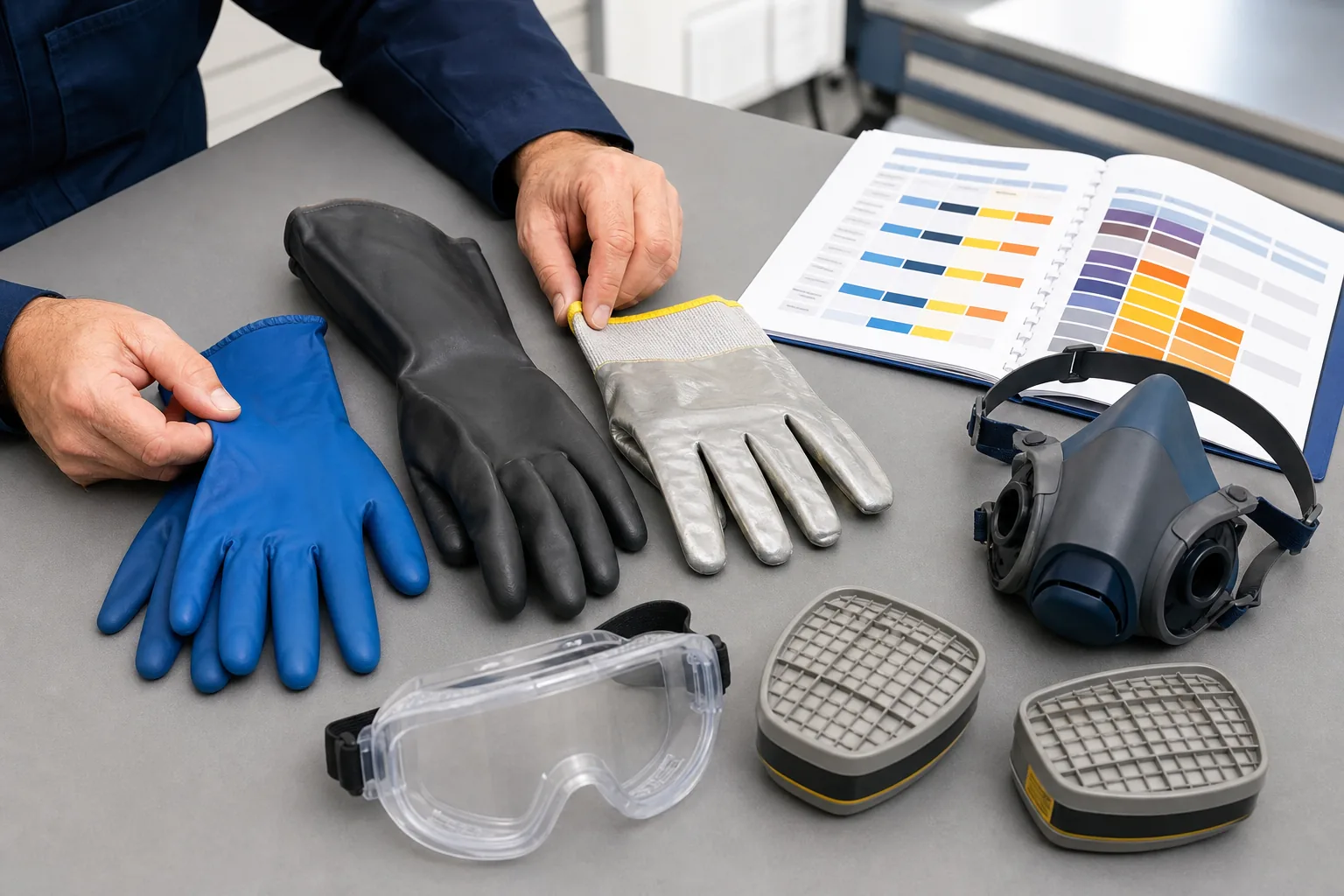
Faced with a chemical risk, the choice of PPE depends on the substance, the concentration, the exposure time and the route of entry. Gloves must be compatible, filters adapted to the contaminant, and an unknown atmosphere requires distancing and alert.
The safety data sheet is the starting point
A chemical product can attack the skin, eyes, respiratory tract or protective materials. The choice of gloves, glasses, clothing or filters must be based on the substance and its safety data sheet when the product is identified.
Nitrile, butyl, neoprene or other materials do not have the same resistance. Breathing cartridges are not interchangeable. A particle filter does not protect against organic vapors or specific gases.
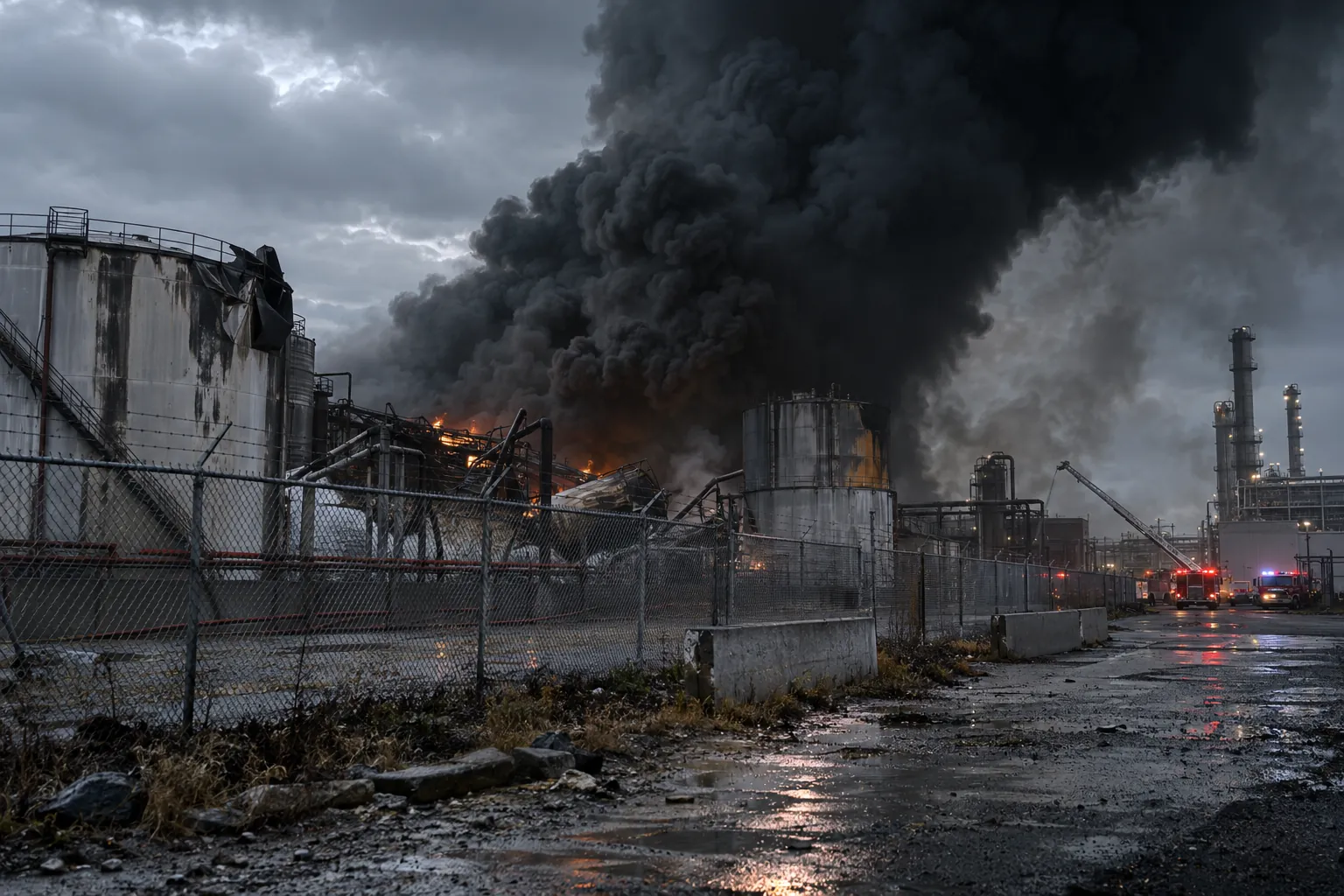
When the substance is unknown, the objective is not to quickly find random equipment, but to move away, prohibit access, ventilate only if this does not create a risk, alert and monitor the instructions.
Refer according to route of exposure
Breathing: adapted mask, half-mask, full mask or cartridge depending on the contaminant. Skin: compatible gloves, covering sleeves, overalls or apron. Eyes: waterproof goggles or visor depending on projection. Clothing: cautious removal and bag if contamination is suspected.
Exposure time: the longer it is, the more critical compatibility, saturation of filters, fatigue, heat and the removal procedure become.
For companies, information and training are as important as stock. Good PPE that is poorly chosen or poorly removed can increase the risk.
Read the technical information before comparing prices
Two gloves that look the same can offer very different resistances depending on the chemical product. The material, thickness, dwell time and condition of the glove should be reviewed with the manufacturer's safety data sheet and tables. A common disposable glove is therefore not a universal answer.
For breathing, the color or the name of a cartridge are not enough. You must know the contaminant, check the type of filter, its class, its duration of use and the storage conditions. An opened cartridge can age even if it has only been worn briefly. In an unknown atmosphere, distancing and calling specialists remains the only prudent decision.
Glasses, visor, clothing and gloves must work together without leaving any area exposed or hindering movements. Before a planned task, perform a dry run in a safe area. You will be able to spot excessive fogging, a sleeve that is too short or poorly controlled glove removal.
Chemical gloves: three failure mechanisms
A chemical can pass through a glove with no visible hole. Penetration, permeation and degradation describe different processes; a visual inspection cannot verify the full protection.
Ask for results for the exact glove model, chemical and concentration. Laboratory breakthrough time is not a guaranteed wearing time for the actual task: temperature, flexing and glove condition also matter.

| Process | What happens | What to examine |
|---|---|---|
| Penetration | Passage through a hole, seam or imperfection. | Integrity and test results for the model. |
| Permeation | Molecular diffusion through the material. | Breakthrough time and permeation rate for the tested chemical. |
| Degradation | Physical changes: swelling, hardening, cracking… | Chemical compatibility and replacement criteria. |
Fit test and user seal check: two different checks
A high-performing filter cannot compensate for a leak between the face and mask. For tight-fitting facepieces, a fit test helps select a model and size for a particular wearer. A competent operator must follow a suitable protocol.
Perform the user seal check each time the mask is put on, following its instructions. It does not replace a fit test. Facial hair in the seal area, spectacle arms or other equipment can disrupt contact; assess the complete combination worn.
| Check | When? | What it establishes |
|---|---|---|
| Fit test | When selecting the model; reassess after changes to the face or equipment. | Whether that model and size fit the person tested. |
| User seal check | Every time the mask is put on, following the manufacturer’s instructions. | No leak detected by that check at that moment; no guarantee for a different hazard. |
INRS · Protection respiratoire : réaliser des essais d’ajustement (ED 6273)
Useful data at a glance
Orders of magnitude and simple controls to adapt to your situation. Local instructions always remain a priority.

To choose a glove
Product, duration and planned task.

Permeation
Consult for each material and product.

Universal
The cartridge depends on the agent and the conditions.
Quick check before you need it
- Read the safety data sheet
- Check material and passage time
- Check the compatibility of the cartridge
- Bring glasses and clothing if necessary
- Organize removal without transfer
Recommended situations and routes
Liquid projection
Eyes/skin priority: glasses, compatible gloves, covering clothing and rinsing if the product sheet indicates so.
Deep: Liquid projection
Odor or vapor
Identify the product. An FFP2 is not sufficient for gases and vapors.
Go deeper: Odor or vapor
Waste or contaminated surface
Limit contact, choose gloves, isolate consumables and do not mix cleaners.
Go deeper: Waste or contaminated surface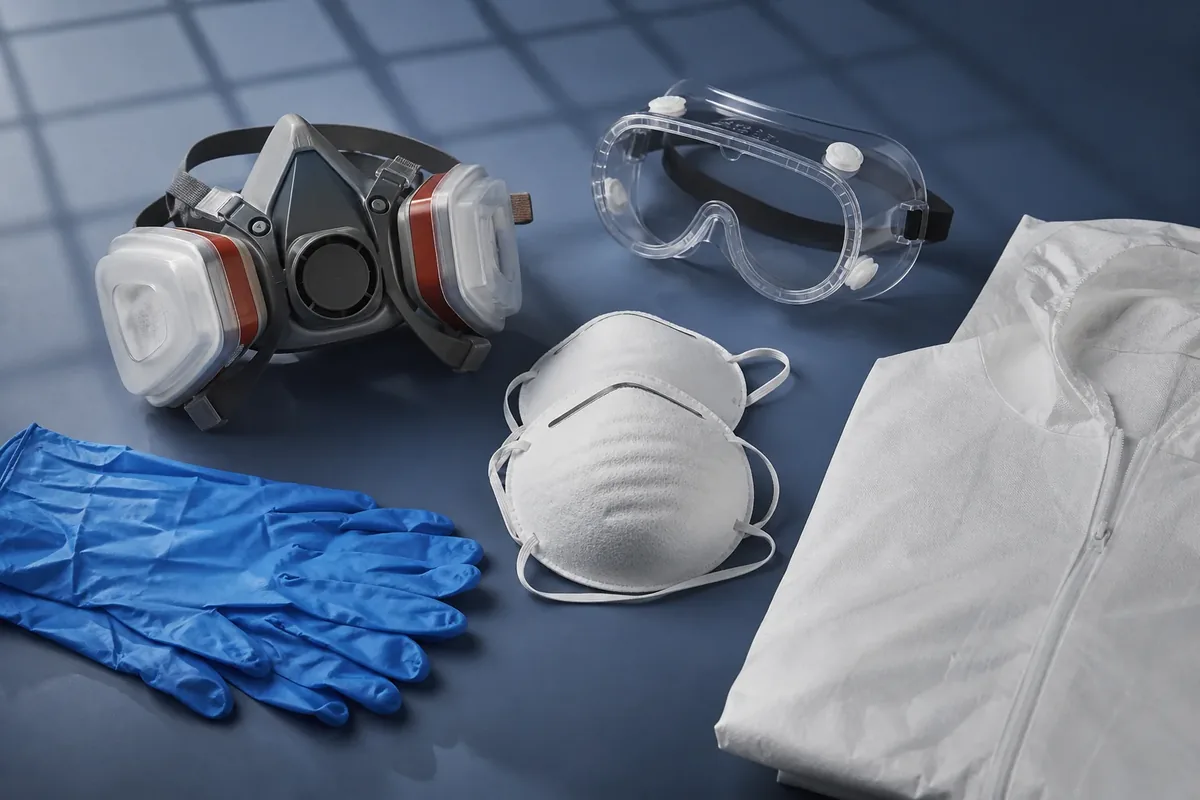
FAQ Chemical PPE
Quick responses to compare uses, limits and protection priorities.
Can I choose gloves at random?
No. The material of the glove must be compatible with the substance and the duration of exposure.
Does an FFP3 mask protect against vapors?
No. FFP3 concerns particles. Vapors require respiratory protection and suitable cartridges.
What to do if the substance is unknown?
Move away, prevent access, alert and wait for a competent assessment rather than testing improvised equipment.
Is there a glove resistant to all products?
No. Compatibility depends on the substance, its concentration, contact time, temperature and the specific model. Consult the SDS and manufacturer's data.
References used for this guide
 INRS - Individual protection against chemical risks
Choice of chemical PPE after risk assessment, limits of protection and need for suitable gloves, glasses, clothing or respiratory devices.
INRS - Protective equipment individual
Reminder that PPE complements risk elimination or reduction measures and must be adapted to the work context.
 Civil security - Industrial accident
Instructions for sheltering, closing openings, stopping ventilation and listening to the authorities in the event of an industrial accident.
Civil security - Transport of dangerous materials
Reflexes when faced with an accident transporting dangerous materials: distancing, shelter, closing vents and respecting instructions.